Cable-Driven Parallel Robots
Hanbang Gao, Christine Chevallereau, Stéphane Caro
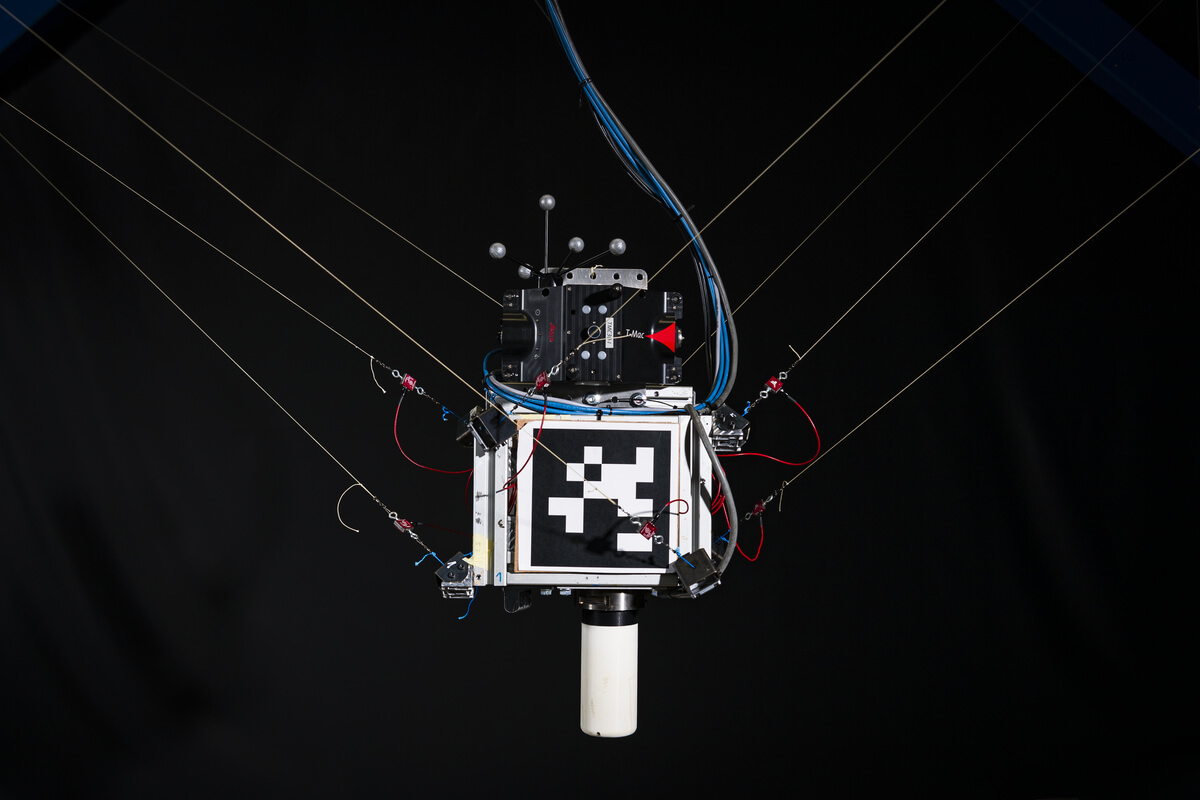
Hanbang Gao, Christine Chevallereau and Stéphane Caro are working to improve safety in collaborative cable-driven parallel robots. Their research has been published in the IEEE T-ASE journal (Transactions on Automation Science and Engineering).
Cable-Driven Parallel Robots (CDPRs) are useful to perform many industrial tasks (machining, painting, parcel delivery, etc.) due to their large workspace, their low mass for their high payload capacity, and and their reconfiguration capabilities. In order to enable co-activation or robot/human collaboration, CDPRs must be designed to physically interact with an operator while ensuring their safety.
In this context, the work carried out at digital sciences laboratory of Nantes (LS2N – CNRS/Centrale Nantes school/University of Nantes) by Hanbang Gao, PhD student at Centrale Nantes school and LS2N member, Christine Chevallereau, CNRS research director at LS2N, and Stéphane Caro, CNRS research director at LS2N, aims to improve safety of collaborative CDPRs using an innovative approach that involves the real-time detection and classification of contacts between the robot and an operator in an industrial application. This approach is composed of 3 steps: estimating the external forces applied to the robot by measuring cable tension, detecting collisions through spectral analysis of the estimated forces over time, and deterministic classification of the contact type based on a weighted notation. The results of experimental validation show that the method is highly reliable, with only 9 failures out of 320 trials.
Find out more
Hanbang Gao, Christine Chevallereau, Stéphane Caro. Enhancing Safety in Collaborative Cable-Driven Parallel Robots: Contact Distinction and Management for Carrying Tasks. IEEE Transactions on Automation Science and Engineering, In press, ⟨10.1109/TASE.2025.3589966⟩.
Other News