Feedback on 1st session “The hard” from the workshop series “The soft, the hard & the weird”

7 – 8 November 2024

ENSCI – Salle Charlotte Perriand
48 rue Saint-Sabin
75011 Paris
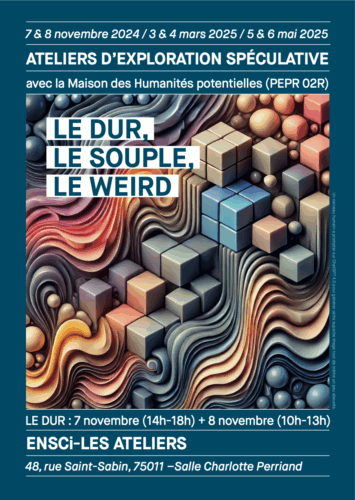
The 1st speculative exploration workshop launched by the House for potential humanities (MHP) in partnership with ENSCI on the topic “The hard” aimed to explore avenues related, directly or indirectly, to organic robotics and its social, philosophical and cultural implications.
Brad Tabas, a philosopher of science and technology at ENSTA Bretagne, proposes to soften our perceptions of the Earth and suggests thinking of it as a soft, flexible, or at least strange being. Challenging the common way of imagining humans standing on hard ground, he proposes a thought experiment: imagining the Earth within the cosmos as we think of octopuses in the marine world.
Julien Wacquez, a science fiction specialist and postdoctoral researcher for the AS3 project at ETIS, proposes to dissect the Dune references in Elon Musk’s tweets or “Xes,” and demonstrates the extent to which the latter draws inspiration from completely outdated hard science fiction.
Emmanuel Grimaud, an anthropologist and coordinator of the House for Potential Humanities, is interested in rheology, this recent science of the deformations of matter, and examines the work of architects on rivers, floods, and the monsoon. Why do we have so much trouble with the phase changes of matter—liquid, solid, and gaseous? How do we do the rheology of the weird?
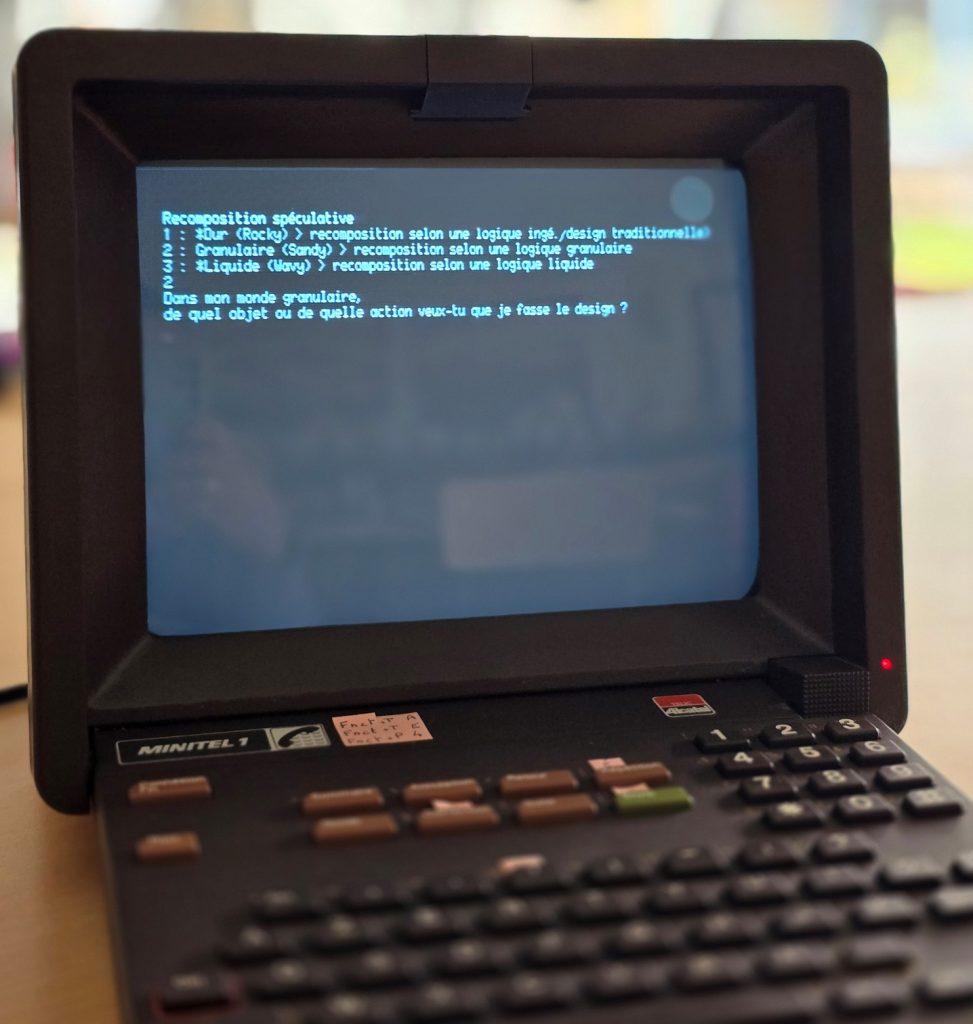
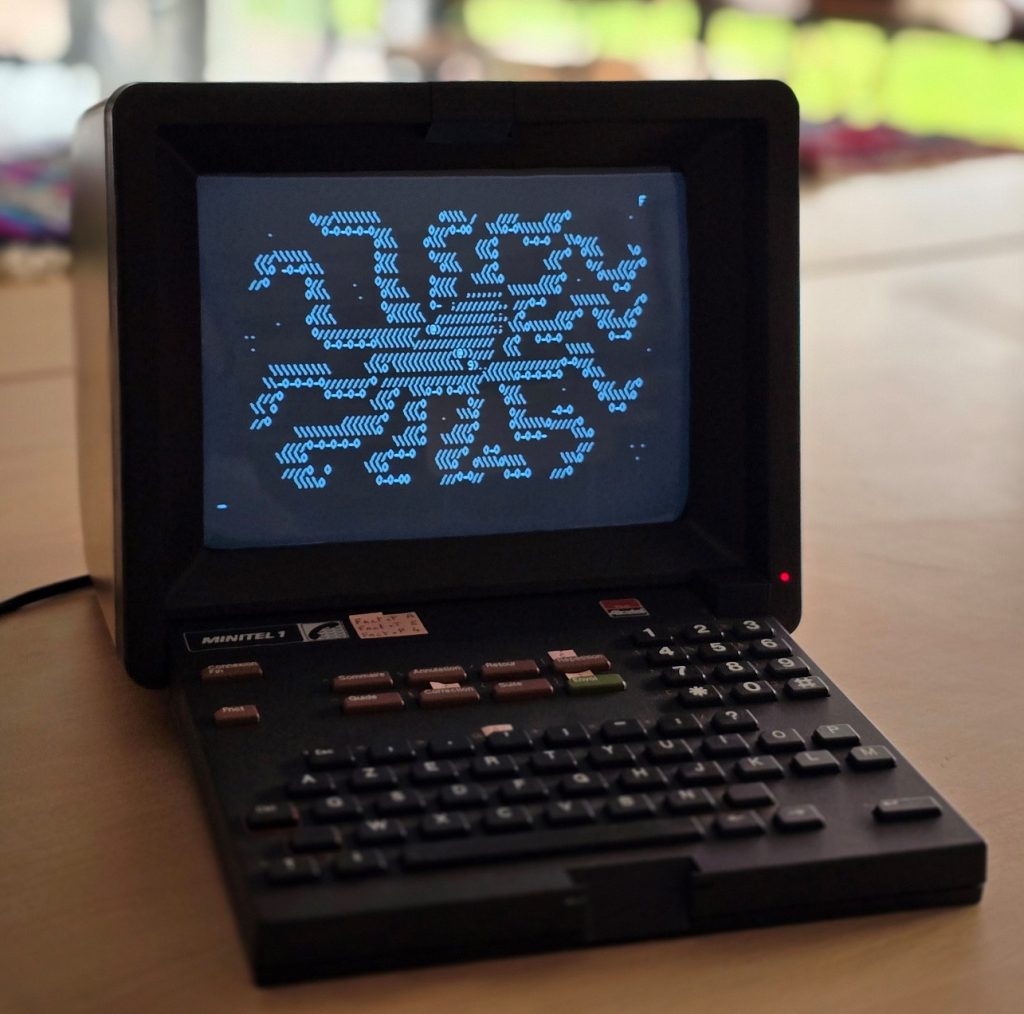
Emmanuel Ducourneau, a designer and postdoctoral researcher for the AS1 project, analyzes sablocene: sand, the second most widely used hard material in the world, found in housing, microprocessors, optics, and metal alloys. He analyzes it from both a material and geopolitical perspective. He presents “Sandy,” a program representing a sand octopus living in a world governed by the physicochemical laws of granular materials and its inhabitants. Like a hermit crab, Sandy is confined within a man-made machine, a Minitel, which erodes with each use, because the hard material can no longer endure.
Grégory Chatonsky, an artist and founder of Incident.net, a Netart platform, shares and comments on the film he created for the city of Le Havre, entirely generated with AI, allowing moving purple shapes to interact with a port city, its swells, and its inhabitants.
More news News