Feedback on “The Internet of Living Things × Soft Robotics”, 2nd masterclass by the Speculative exploration workshops

18-19-20 May 2026


MSH Mondes / Université Paris Nanterre
200 avenue de la République
Bâtiment Weber – Maison des Humanités Potentielles
Allée de l’Université
92500 Nanterre
From 10am to 5pm
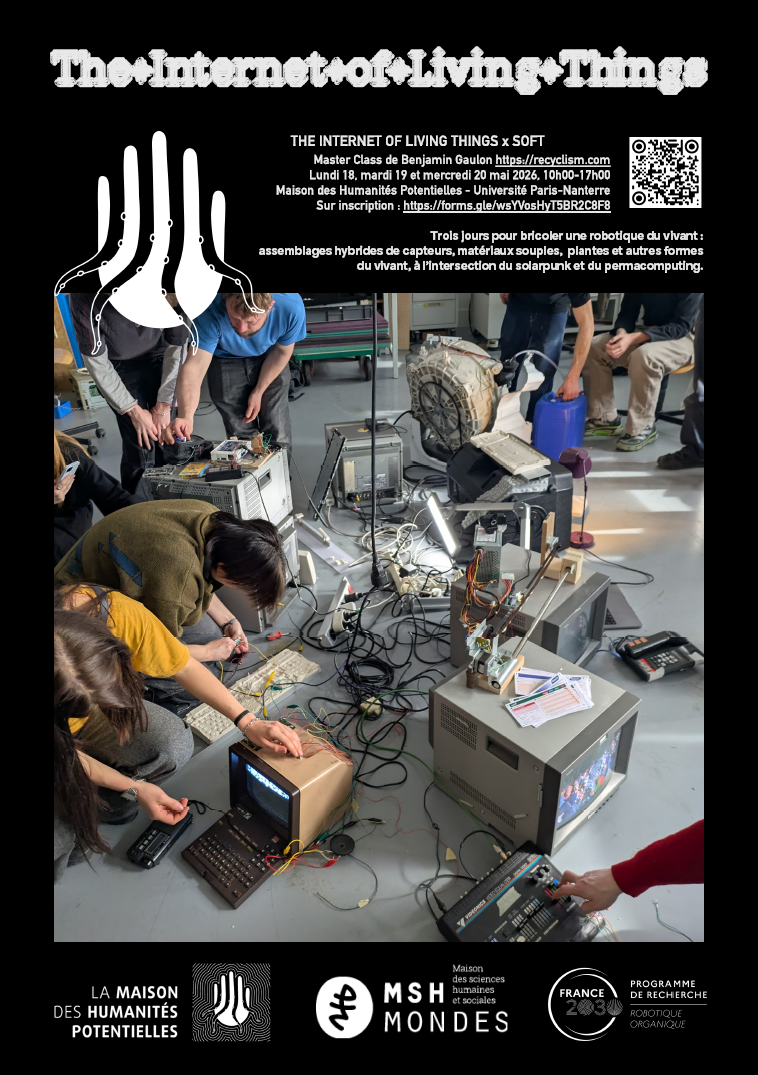
The 2nd masterclass by the Speculative exploration workshops, organised by Nathalie Guimbretière, postdoctoral researcher at House for potential humanities (MHP), and Benjamin Gaulon, artist-researcher and teacher, in partnership with MSH Mondes, took place over 3 days, structured around the interconnections between soft robotics, connected living systems, and technological imaginaries.
Summary
This masterclass explores robotics in symbiosis with living organisms, from a solarpunk and permacomputing perspective. Participants will develop experimental devices capable of interacting with plants, microorganisms and terrestrial or aquatic environments. The workshop combines prototyping, observation and analysis. Prototypes are conceived as hybrid assemblages bringing together humans, non-humans, materials, sensors and environments. The aim is thus to examine the distributed capacity for action that unfolds between living organisms and technical devices.
Concepts covered. Solarpunk. A cultural and political movement that envisions a desirable ecological future, where nature and technology coexist in a cooperative manner. Permacomputing. The application of permaculture principles to digital technology: sustainability, reparability, and material and energy efficiency. Technological symbiosis. The reciprocal interaction between technical systems and living organisms, conceived as an exchange rather than instrumentality. Soft robotics. Robotics based on the use of flexible materials, promoting more organic and less invasive interactions with the environment.
Benjamin Gaulon is an artist-researcher and teacher. His work explores the environmental and social impacts of consumer technologies. Since the early 2000s, his practice has addressed issues such as planned obsolescence, consumerism, consumer society and consumer culture through circuit bending, hardware hacking and media archaeology.
Concept of the speculative exploration workshops
These open-ended workshops aim to explore avenues related, directly or indirectly, to the future of our technologies and their social, philosophical, and cultural implications. These workshops are open to everyone, in addition to researchers from the PEPR O2R research group and students from affiliated art and design schools.
Note: It is not necessary to have participated in the earlier sessions to attend this one.
Is hardness always rigid? Is softness necessarily soft? Is fluidity necessarily liquid? Should we persist in solidifying everything, or on the contrary, strive to liquefy everything? What urgently needs to be made softer? At what point do we cross into the realm of the weird? How do we distinguish between the persistence of hardness, the promises of softness or viscosity, and the risks of the weird?
This workshop explores and develops the visual imagination of the hard, the soft, and the weird, in engineering, design, science fiction, and far beyond, in all their forms and states, without creative or disciplinary limits. Through performative readings of texts, viewings of cinematic, literary, or choreographic works, the creation of experiments and scenarios, and meetings with artisans, artists, designers, researchers, and experimenters who explore the properties of the transient states of matter, whatever its nature. For its second year, the MHP will offer regular sessions in the form of debates and explorations of matter.
Feedback
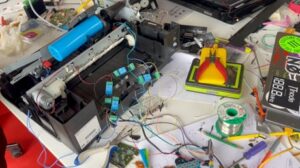
On 18, 19 and 20 May 2026, fourteen participants from a variety of backgrounds — designers, artists, graphic designers, performing arts practitioners, students from ENSAD and ENSCI, a PhD student from the CRD, and researchers from the PEPR O2R — tinkered with living robotics under the guidance of artist-researcher Benjamin Gaulon: hybrid assemblages of sensors, flexible materials and repurposed electronics, at the intersection of solarpunk and permacomputing.
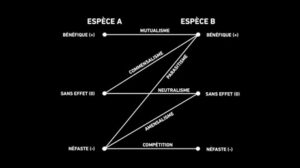
Starting from a working fiction—the Internet of Living Things Institute and its simple question: how can technology stop extracting and start coexisting?—the workshop viewed the tree as an existing infrastructure, and sought to entrust it with our devices rather than simulate nature. Objects capable of perceiving their environment and communicating with one another, conceived through the modes of relationship found in ecology — parasitism, commensalism, symbiosis, and that more unstable graft which sometimes becomes one with the tree. Several prototypes emerged: capturing the tree’s vibrations with a geophone, yeast cultures integrated as active partners, or a device that inflates a flexible volume when a distant sensor detects a presence in the foliage. A masterclass that was an invitation to imagine objects hanging from a tree, attentive, almost alive.
More news Seminars