REINVENTing prosthetics
Credits: © Philippe Gauthier – ISIR
Coordinator
Nathanaël Jarrassé, CNRS research director at Institute of Intelligent Systems and Robotics (ISIR – CNRS/Sorbonne University)
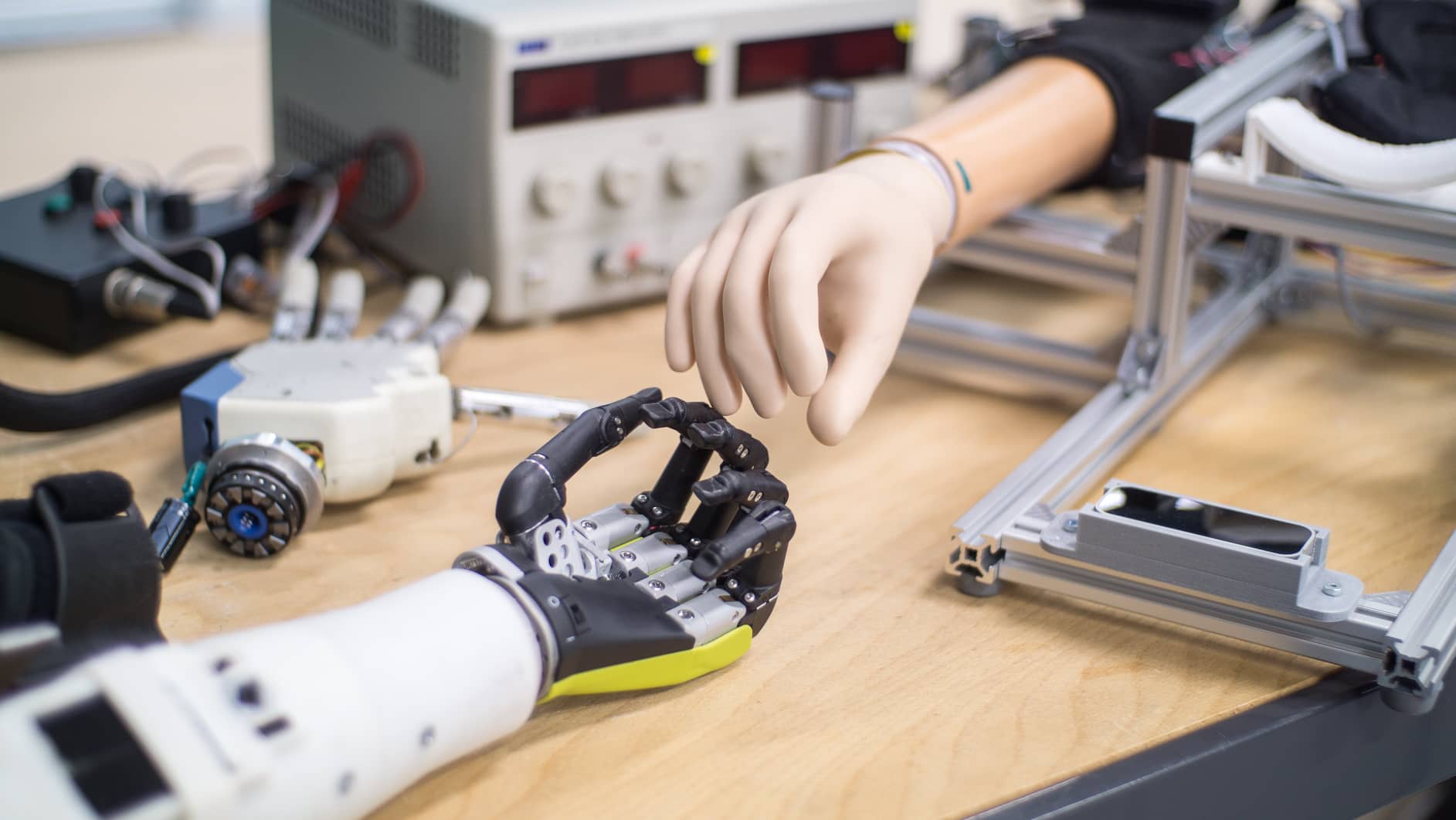
The upper limb prosthesis raises technological challenges (robotic, biomechanical and neuroscientific). It also constitutes an ultimate sensorimotor extension as many more general questions relating to the humanities and social sciences (HSS) come up. These questions deal with the relationship to the body, the hybridization of body and technology, the uses and their consequences on the lives of users, appropriation, body repair or modification (therefore care), identity and body image for oneself and society, associated norms and injunctions, etc.
Despite recent technological advances, the abandonment rate for upper limb prostheses remains high, and incremental technological innovations do not seem to have been enough to revolutionize the prosthesis or the relationship between amputees and their technical aids. This observation reveals the existence of a certain mismatch between, on the one hand, the needs and uses of amputees and, on the other hand, the technological solutions proposed so far. For a majority of amputees, prostheses remain heavy, rigid, slow, not very “sensitive” (not offering sensory feedback), rarely versatile, not very customizable, and difficult to control.
The aim of this integrated project and the creation of a dedicated interdisciplinary team is, therefore, to develop an innovative concept for a customizable prosthesis for upper limb amputees that behaves more like a natural limb, that is easy and pleasant to wear, that is more intuitive to control; a prosthesis that restores sensations and integrates with the body. A prosthesis that, having become usable and effective, hence useful, is no longer abandoned by its users and valorizes them. Our overall hypothesis is that the only way to meet the needs of these users is to “reinvent the prosthesis” by proposing a radically different concept (or set of concepts), by exploring, at the same time, the multiple issues aforementioned (mechanics, control, perception, learning, as well as bodily, individual and social integration) and by ensuring that the users are involved throughout the research process.
Several main results will be achieved in this project. We will develop a light and compliant mechatronics coupled with intuitive control approaches which allows a better reproduction of the human movement and is able to perceive and transmit exteroceptive and proprioceptive sensory feedback. And this will be achieved in close interaction with HSS, to understand the uses, the place and the role of the prosthesis, and by extension of other technical aids such as exoskeletons which share similar problems, but also to facilitate the dialogue between users and designers (co-design); as well as a better understanding of the influence of the questions of individuality, normativity and efficiency in the field of technical aids.
A major feature of the project is the strong involvement of amputees, i.e., user experts, in the project. They will be recruited by each technical partner of the consortium, in order to involve them throughout the development phases and to try to co-construct a technological response that is as accurate as possible, to personalize this response, and to train users (in particular through the creation of a “sport with prosthesis” club).
Keywords: Customizable prosthesis, co-design, sensory feedback, body integration, interdisciplinarity
Objectives
To develop a customizable upper limb prosthesis that is more intuitive to control and offers sensations close to a natural limb.
To integrate light and soft mechatronics approaches, combined with intuitive control to improve mobility and sensory feedback.
To reinvent the relationship between amputees and their prostheses in taking into account technological, perceptual, social and identity aspects.
To involve actively amputee users throughout the research process, promoting co-design in order to precisely meet their needs.
To explore the social and normative dimensions of prostheses, while facilitating the integration of users into society and the recognition of their individuality.
Consortium
Sorbonne University
University of Claude Bernard Lyon 1
University of Lumière Lyon 2
University of Panthéon-Sorbonne 1
University of Lorraine
University of Aix Marseille
University of Nantes
INSA Rennes
CEA
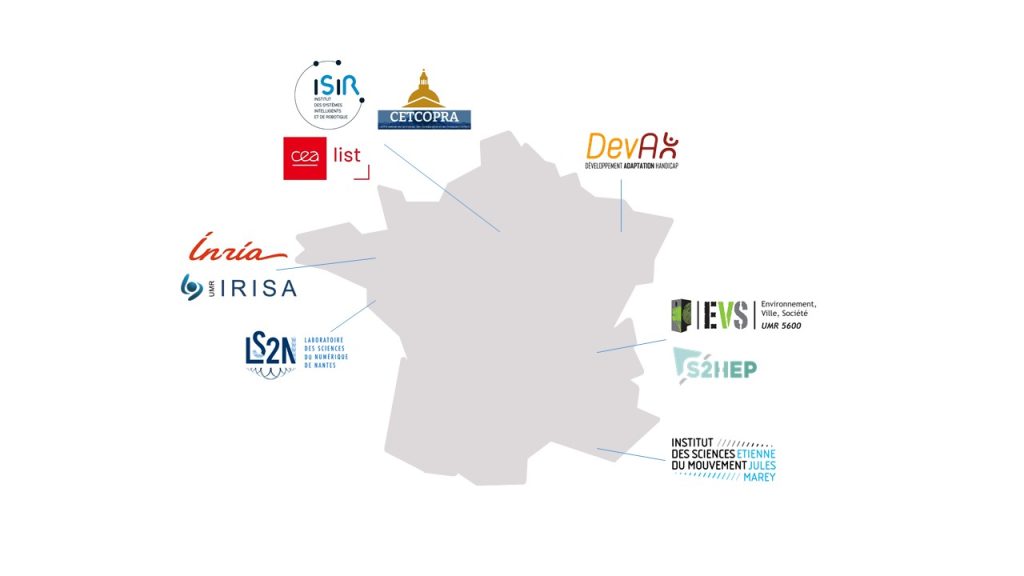
Establishment of the consortium
Other PEPR projects