Elisabetta Zibetti, Raphael Lorenzo, Joffrey Becker, Bertrand Luvison and Serena Ivaldi, HSS and robotics members of the AS3 project, with the help of Julien Wacquez and Fabio Amadio, are working on how groups (vs. individuals) engage with a service robot in the real world. Their research has been published in the HRI Companion ’26: Companion Proceedings of the 21st ACM/IEEE International Conference on Human-Robot Interaction.
How does interaction with robots differ between spontaneously formed groups and individuals?
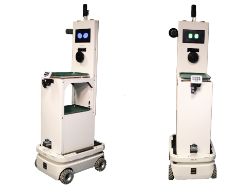
Despite increasing robot deployment in public spaces, this question remains understudied in real-world settings. We conducted a field study deploying a service stationary robot in semi-public office spaces, tracking 221 individuals (42 alone, 179 in groups) across 95 interaction opportunities.
Cookies were placed on accessible trays, creating a low-barrier functional interaction opportunity (taking a cookie) while allowing observation of spontaneous social behaviors. Groups demonstrated significantly higher engagement: functional interactions and social gestures. Within groups, leader presence amplified social engagement threefold. These findings are consistent with descriptive norm theory: group presence and leader behavior were associated with increased social engagement, though context-specific factors may moderate these effects.
Results highlight the potential value of group detection for robots in multi-user environments, and demonstrate the feasibility of integrating psychological theory with automated tracking to study spontaneous human-robot encounters in the wild.
Find out more
Zibetti, E., Lorenzo-Louis, R., Amadio, F., Wacquez, J., Becker, J., Luvison, B., & Ivaldi, S. (2026). Group-Robot Interaction in the Wild: An Exploratory Field Study in Semi-public Spaces. HRI Companion ’26: Companion Proceedings of the 21st ACM/IEEE International Conference on Human-Robot Interaction, Edinburgh, Scotland, UK. https://doi.org/10.1145/3776734.3794463
More news News